

Curatorial Review
by Oleksandr Dyvnich
Danielle Vibert works in clay the way a geologist reads a cliff face — attentive to strata, to the marks time and pressure leave behind. Across the body of work surveyed here, from wheel-thrown functional ware to freestanding sculptural forms, a consistent preoccupation emerges: the ceramic object as a small, handleable landscape. Glaze becomes weather; the kiln becomes climate. It is an ambitious conceptual frame for a medium so often confined to the domestic shelf, and Vibert largely earns it.
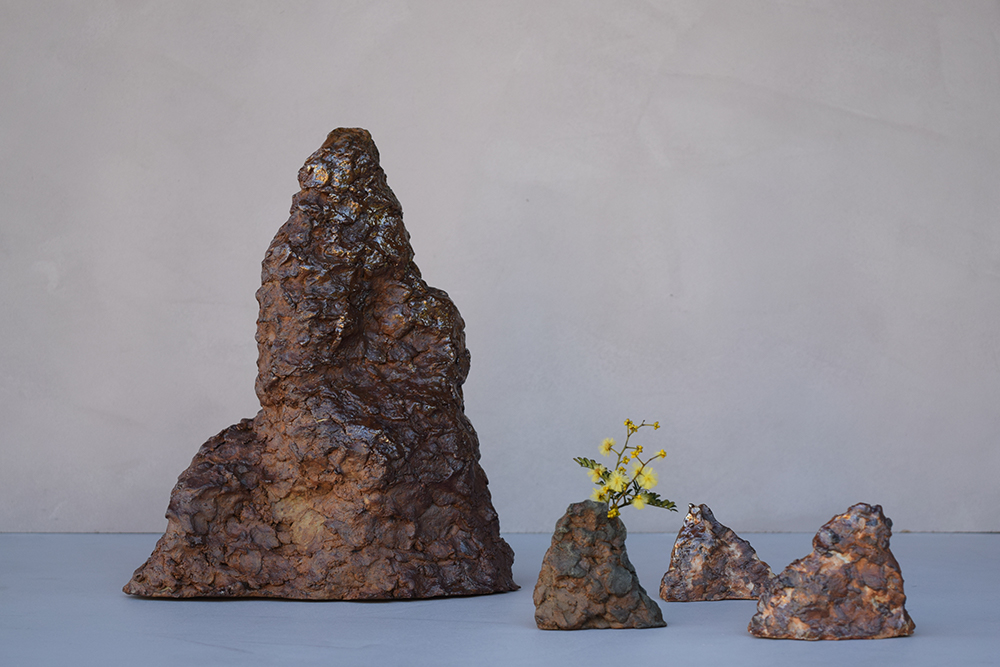
Danielle Vibert | Resting Range | 2025
Resting Range (2025) is the strongest articulation of this idea. A cluster of rough-textured, mountain-like forms — one dominant peak flanked by three smaller outcrops — is finished in a mottled, oxidised surface that recalls scorched rock or rusted iron ore. A single spray of yellow acacia blossom, tucked into a fissure in the smallest form, activates the whole grouping: it turns geology into habitat, and the piece reads less as a vessel than as a diorama of survival. The gesture is simple but effective, and it is the clearest evidence in this survey of Vibert thinking sculpturally rather than merely decoratively.
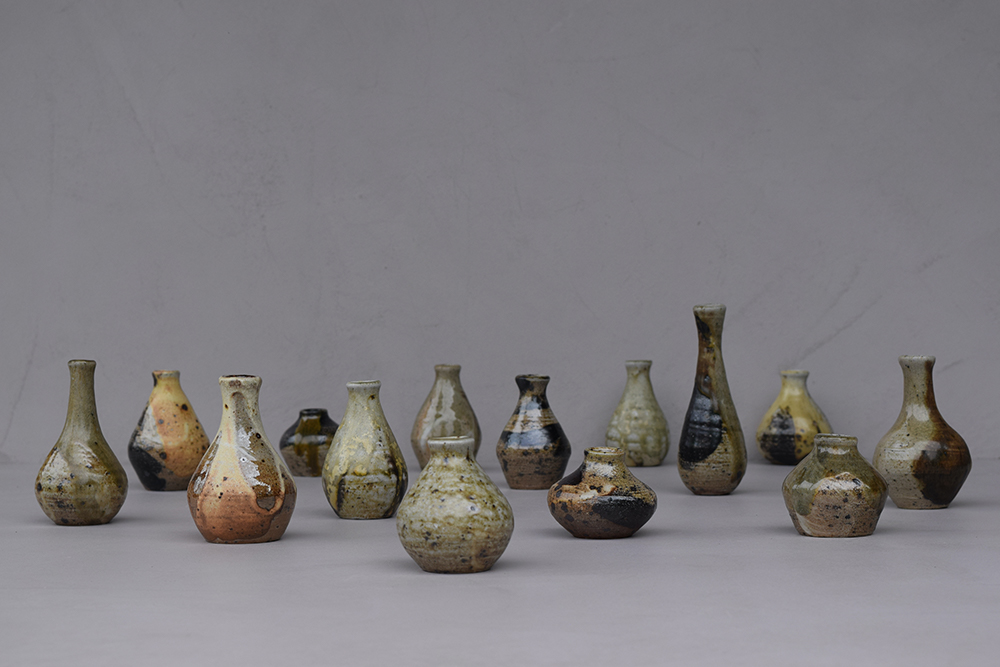
Danielle Vibert | Salt Bud Series | 2025
The Salt Bud Series and What Grows / Returns extend this landscape logic into more conventional vessel territory — miniature bottle forms and taller ribbed cylinders, respectively, both glazed in ash-and-mineral palettes of ochre, olive, and iron-black. Grouped together, the bud vases behave almost like a scattered rock garden or a colony of seed pods; individually, several feel underdeveloped, their necks and shoulders slightly generic where the surface treatment is doing most of the expressive work.
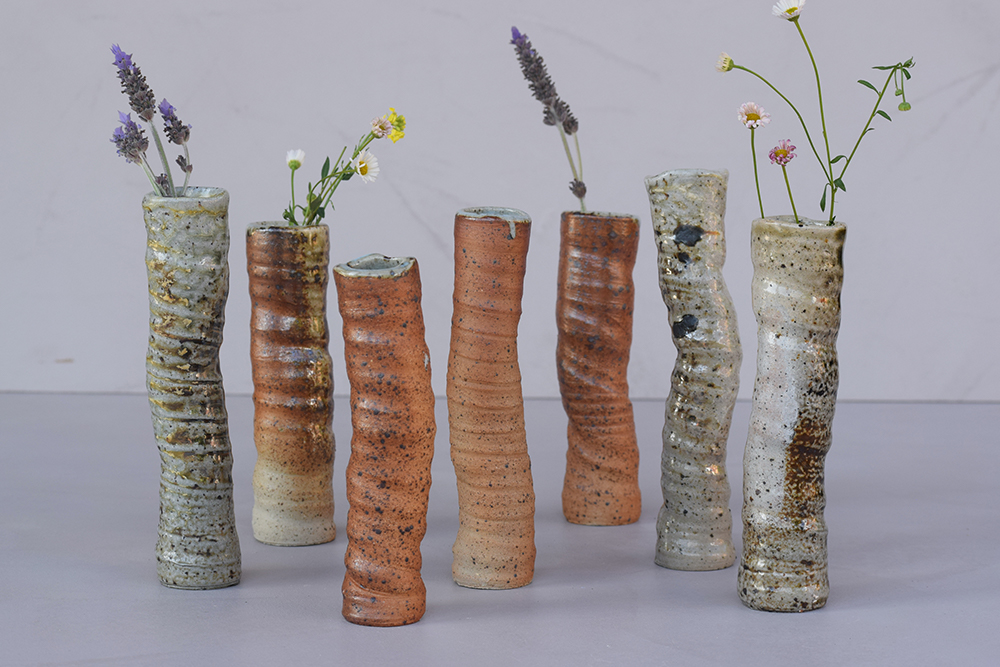
Danielle Vibert | What Grows, Returns | 2024
The taller vases in What Grows / Returns are more confident: their twisted, hand-ridged walls give the glaze somewhere to pool and break, and the wildflowers photographed in them make the growth-and-return metaphor legible without being heavy-handed. Still, the title’s ambition — a statement about cycles, return, renewal — is only partially matched by the forms themselves, which read more as accomplished studio pottery than as a fully resolved thematic statement.
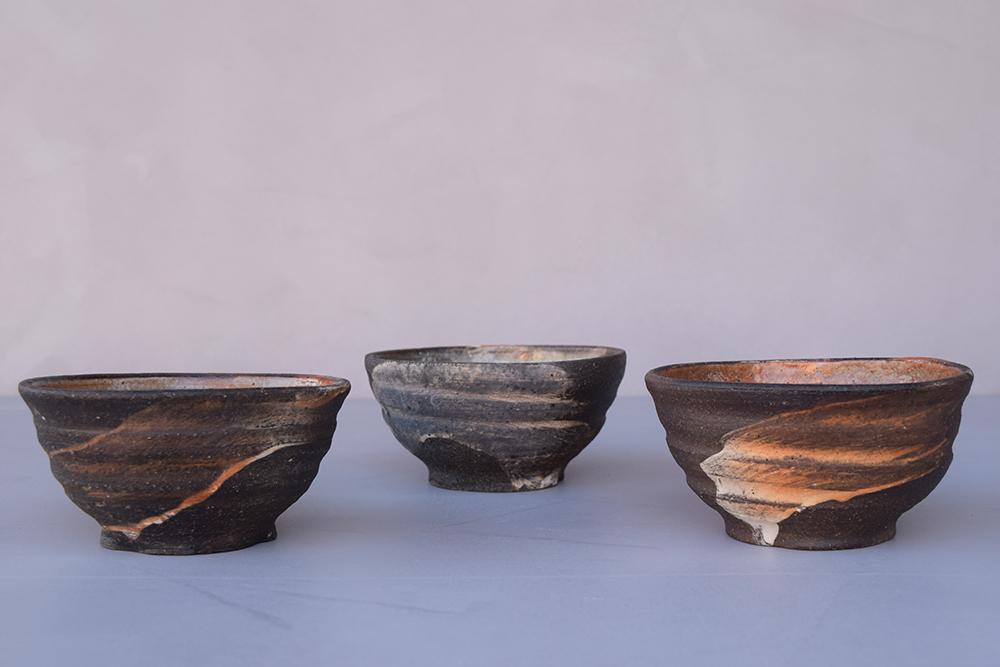
Danielle Vibert | Sandstone and Graphite Series
The Sandstone and Graphite Series bowls are the most technically assured pieces here. Dark, almost graphite-toned exteriors are interrupted by broad, unglazed streaks of warm sandstone-orange, a controlled contrast that suggests exposed rock beneath a mineral crust. The effect depends on precise glaze application and kiln placement, and Vibert handles it with restraint — the streak is allowed to feel accidental even though it plainly is not. This is where the geological conceit stops being a metaphor announced in a title and starts being something achieved in the material itself.
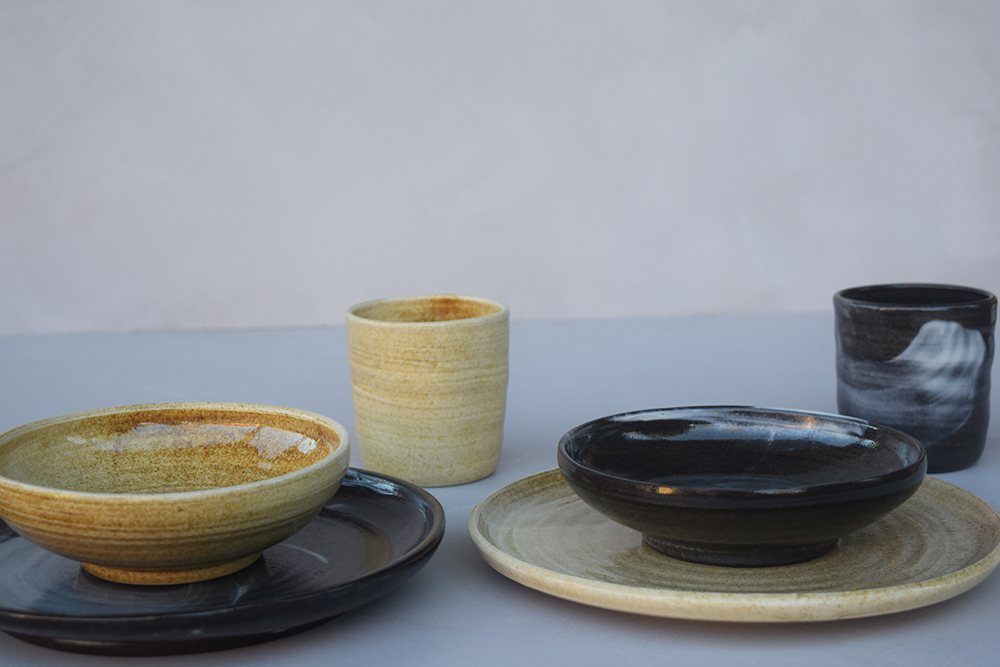
Danielle Vibert | 2025
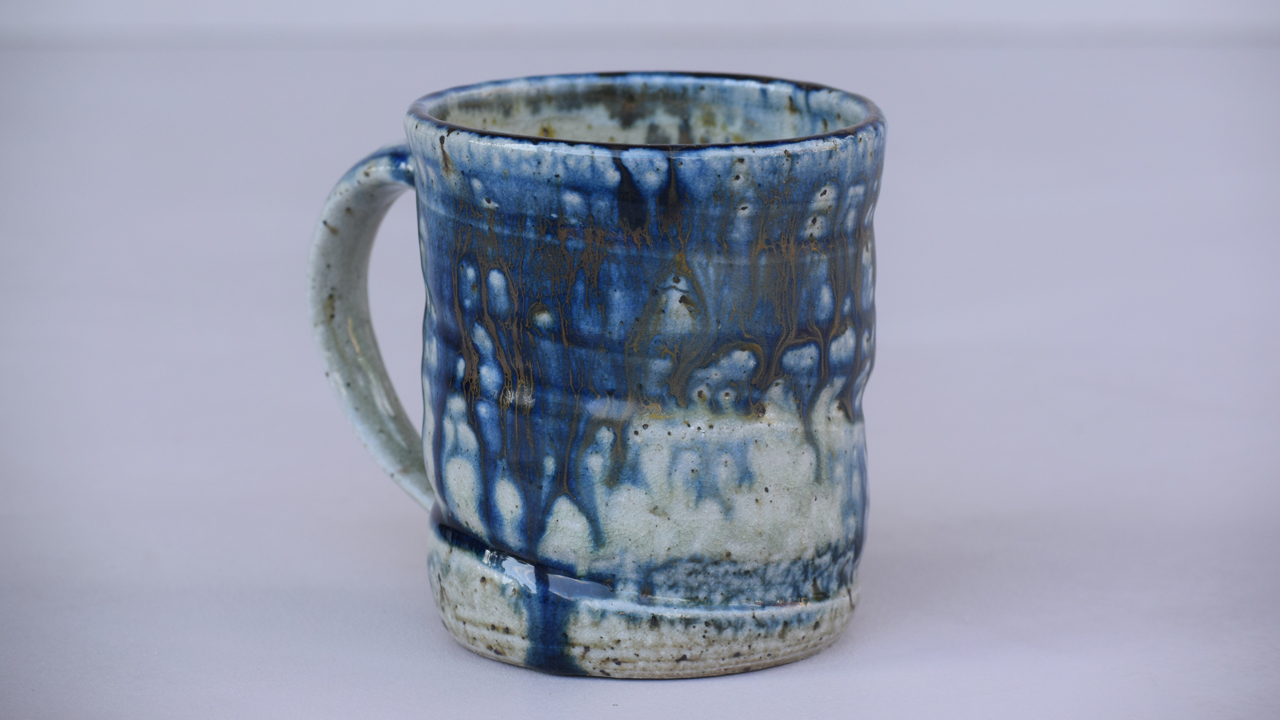
The functional pieces are more mixed. The 2024 mug, with its cobalt-blue drips breaking over a crackled, speckled ground, is competent and appealing but sits stylistically apart from the rest of the survey — its palette and drip technique recall a fairly familiar studio-pottery vocabulary rather than Vibert’s own landscape language. The tableware grouping (bowls, plates, and cups in mustard, black, and cream glazes) is well made and coherent as a set, but as critical material it is the least distinctive work on view; it demonstrates skill without advancing the conceptual thread that makes the sculptural pieces compelling.
What unifies the work is a serious, unfashionable patience — a willingness to cede authorship to material and flame, and to let each piece carry the trace of its own making. Vibert is not reinventing the wood-fired vessel so much as testing how far its ancient grammar can be pushed toward landscape without losing the intimacy of the hand. On this evidence she has the technical command to go further, and the more interesting path lies not in making the pot look more like a mountain, but in trusting the mountain that already lives in the clay.