
Curatorial Review
by Oleksandr Dyvnich
Cycle of Civilization is a series of graphite drawings made in 2023 by Czech self-taught artist Petr Václavek, working under the name PBV. The series carries a double origin: a meditation on civilisational decline and, beneath that, the intimate crisis of accompanying a daughter through her final hours. This layering — of the public and the devastatingly private — is where the work’s real tension lies, and where its most significant questions are posed.
The choice of graphite is not incidental. Where paint implies completion and colour implies vitality, graphite is the medium of the provisional: of preparation, of drafts, of things not yet resolved — or perhaps never to be resolved. Václavek’s grey, tonally dense surfaces carry both the patient labour of someone working through grief and the visual vocabulary of entropy: everything in varying states of collapse, accumulation or abandonment. Nothing is luminous. Nothing escapes the grey.

PBV /Petr Václavek | Overgrowth | 2023
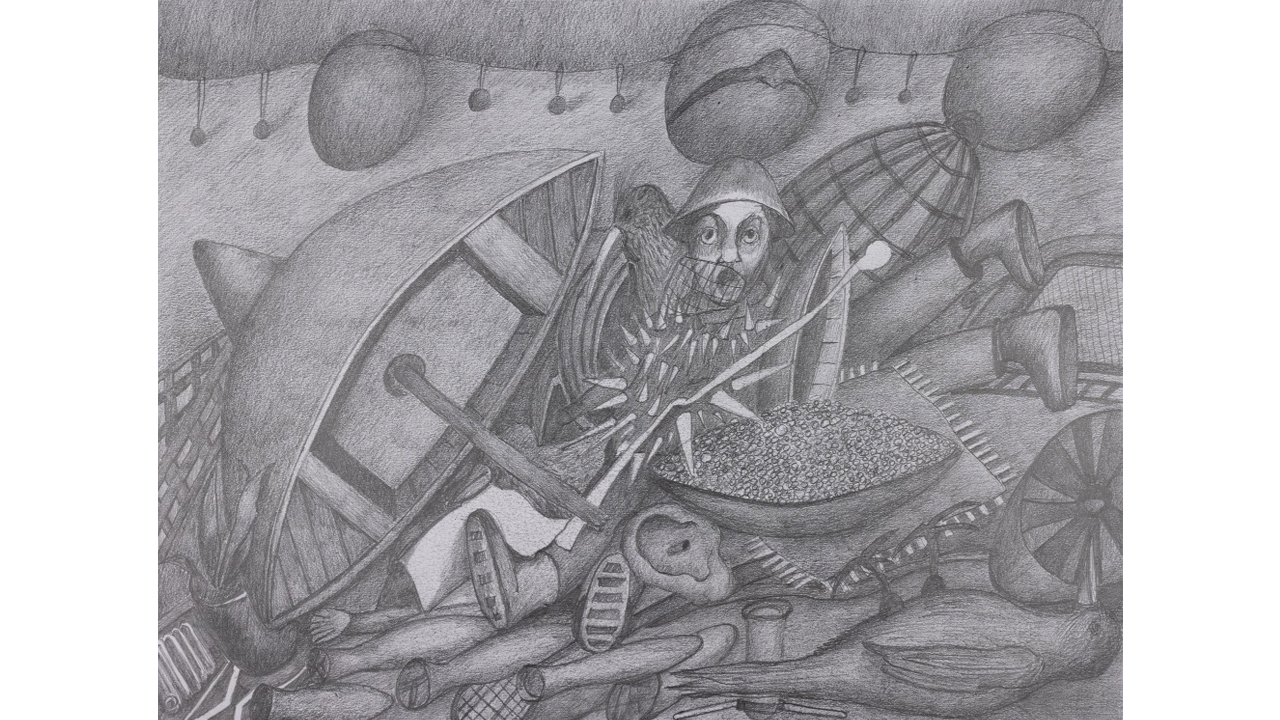
The formal language across the series is insistently material: piled debris, broken machinery, splintered wood, cylindrical tubes, wheels and bones. Mechanical Confusion places a skeletal, helmeted figure at the centre of catastrophic accumulation — orbs suspended above like a stopped metronome, the figure’s face wide-eyed and caught, part human, part machine. The image draws on Central European surrealism and the tradition of the morality print, but the energy is less allegorical than panicked: this is not a figure overseeing collapse but one buried in it. Overgrowth and The Empty Ark represent the aftermath: in the first, mechanical creatures with blank circular eyes lie half-buried beneath fallen trees and crumbling structures; in the second, a wrecked vessel rests among debris with no passengers, no purpose, no cargo. The Noah’s ark reference is quiet but pointed — salvation’s architecture persists after salvation has failed.

PBV /Petr Václavek | The Empty Ark | 2023
Collective Helplessness is the most politically legible drawing in the group: masses of featureless, hooded figures fill the upper field in passive uniformity, while below, individualised faces scream and reach around a caged sphere — globe, bomb, or surveillance apparatus. The spatial division carries a precise social argument: those who know are overwhelmed; those who do not vastly outnumber them and feel nothing.

PBV /Petr Václavek | Collective Helplessness | 2023
Dehumanizace offers a different register: two large figures in gas masks, wearing civilian clothes, seated in postures of resigned exhaustion. The grotesque insect-like heads and the pitifully ordinary shoes and trousers are in productive tension — the human remains legible inside the monstrous apparatus, barely.

PBV /Petr Václavek | Dehumanizace | 2023
The biographical centre of gravity is Transition. A hooded, gas-masked figure stands vigil over a boat-shaped vessel containing a reclining, wrapped form — a body, a patient, a dying child. The gas mask, recurring across the series, here finds its most precise meaning: the grieving person sealed off from the air of terminal illness, present but quarantined, touching without being able to touch. Other masked and deformed faces gather at the edges, witnesses who cannot intervene. A potted plant in the foreground introduces the only unambiguously living thing in all six works — small, domestic, somehow unbearable in its indifference.

PBV /Petr Václavek | Transition | 2023
As a body of work, the Cycle of Civilization achieves considerably more than its title suggests. The civilisational frame occasionally risks converting intimate loss into grand metaphor — a move that the most schematic drawings do not entirely resist. But this friction is also the series’ principal strength: a private wound that insists on finding its scale in the world. Václavek, working without formal training and under the immediate pressure of grief, has produced a suite of drawings in which the question of what civilisation is for — whether it protects us, sedates us, or simply outlasts us — is not argued but felt. The graphite does not permit distance. Grey is the colour of neither mourning nor hope, and that refusal of resolution is precisely where these images locate their authority.