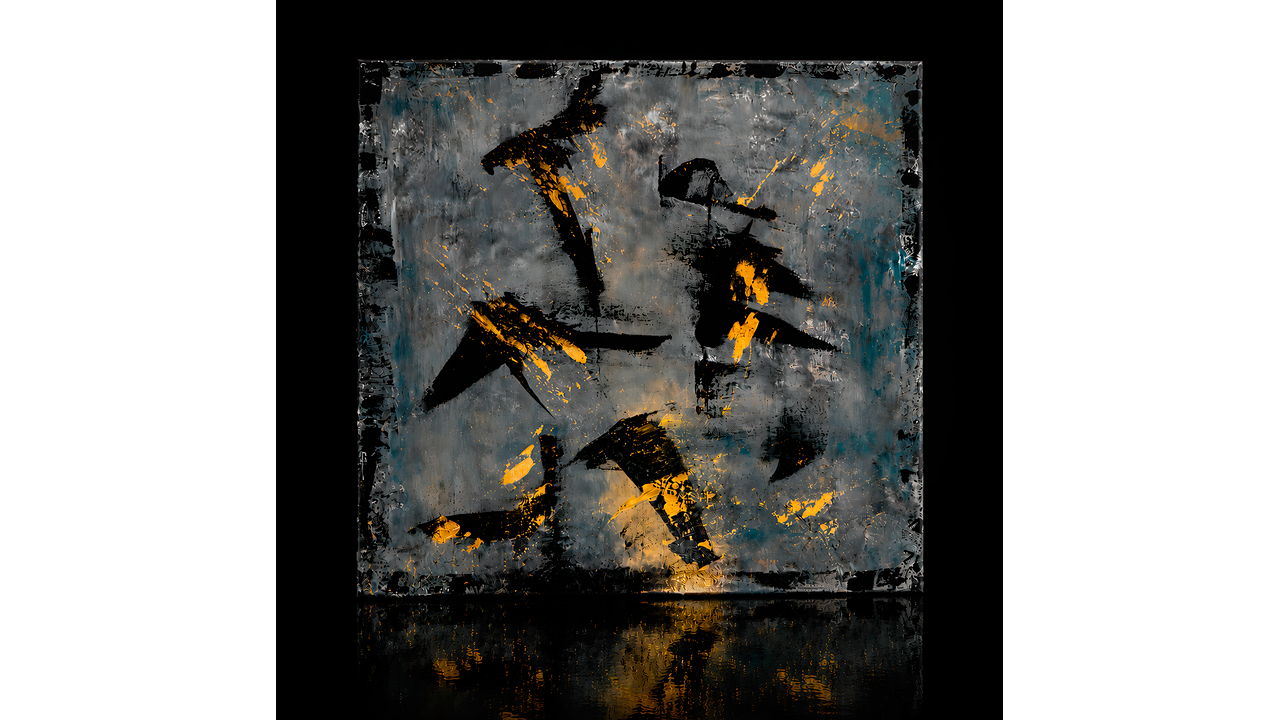

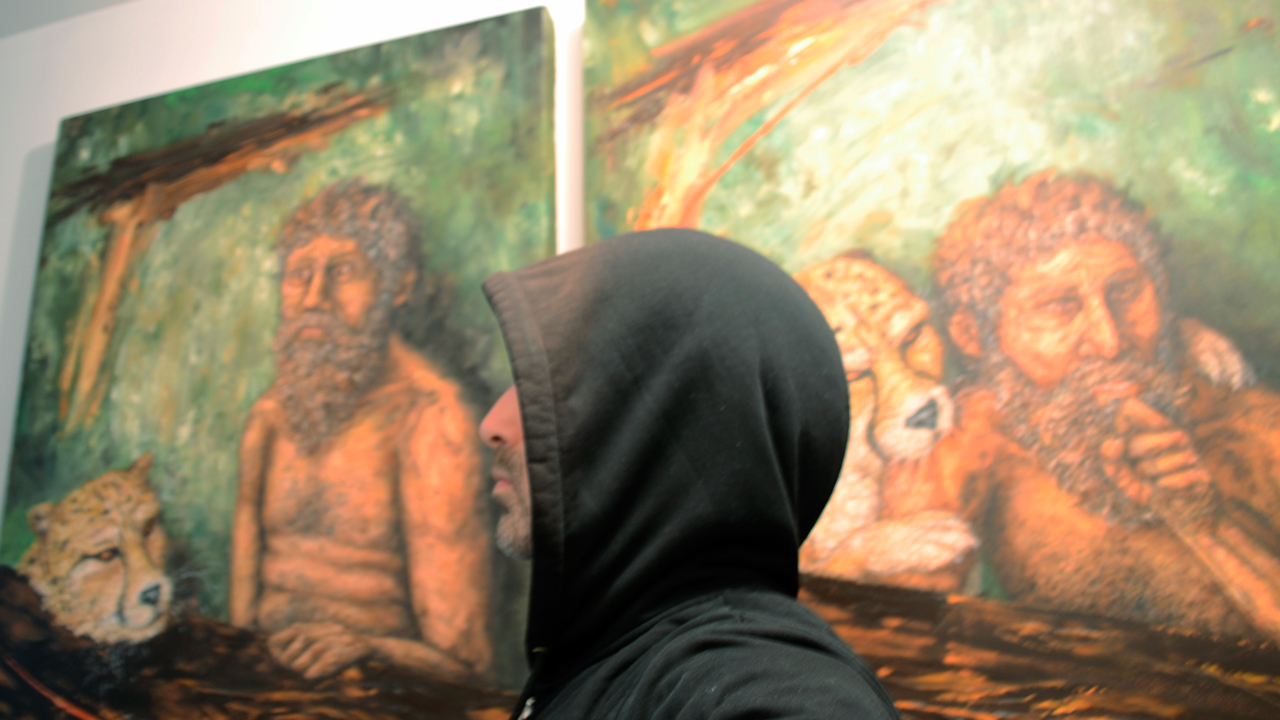
Nadim Touma’s contemporary oeuvre operates within a complex, highly charged tension between physiological architecture, existential vulnerability, and the radical heritage of Canadian Automatism. Guided by Jakob von Uexküll’s foundational concept of the Umwelt—which asserts that every organism inhabits a strictly self-contained, sensory-subjective bubble—Touma translates the invisible cognitive borders of non-human species into tangible, visceral painterly realities. Rather than rendering animal subjects as mere vessels for human allegory or passive objects of scientific categorization, his canvases act as psychological thresholds. They invite the viewer to witness the volatile friction where instinctual drive confronts physical or psychological displacement.

Nadim Touma | Classification II | 2021
This thematic core is explicitly realized in Classification II (2021), where three owls are depicted trapped inside an explicitly delineated wooden box. Touma masterfully turns this specimen tray into an arena of psychological resistance. The birds do not sit in static, taxidermic submission; instead, their heavy impasto wings beat frantically against the constraints of the frame, fracturing the space into an anxious blur of muted ochres and deep browns.

Nadim Touma | The Nap | 2026
This claustrophobic tension undergoes an even darker, institutional transformation in The nap (2026). Here, a domestic interior dissolves into a macabre, womb-like chamber rendered in bruising crimson and visceral pinks. The presence of avian sentinels alongside mummified human skeletons nestled within wall alcoves blurs the boundary between sleep and permanent rest. The painting challenges the human monopoly on consciousness, suggesting a shared, subterranean matrix of trauma, memory, and somatic decay where animals stand as witness to our ultimate fragility.

Nadim Touma | Samples of Sand | 2024
When Touma pivots away from explicit figuration, his mark-making retains its psychological gravity, evolving into an aesthetic of historical and spatial rupture. Samples of sand (2024) functions as both a geographic and emotional excavation. Echoing the artist’s roots in a war-torn Lebanon, the stratified composition resembles an exposed, bleeding cliffside or a scarred landscape. Thick, aggressive gashes of volcanic orange, iron rust, and raw crimson disrupt the neutral earth tones, evoking a sudden eruption that tears through geological and chronological time.

Nadim Touma | Shriek | 2023
This kinetic urgency reaches an auditory climax in Shriek (2023), where the canvas yields completely to gestural expressionism. A violent vortex of icy blues, stark whites, and bruising purples sweeps diagonally across the frame, physically dragging the eye through a whiplash of paint application that mimics a sudden psychic shock.

Nadim Touma | Where Are the Candles | 2026
Where Are the Candles (2026) is equally dense, staging a chaotic interior where ghostly figures carry objects through a space overloaded with carpets, framed pictures, menorahs, urns, and a horned figure presiding from an archway above. The painting vibrates with anxious energy. Its subject — the looting, dispersal, or evacuation of cultural objects — feels urgently contemporary, and the compositional instability enacts the theme rather than merely illustrating it.

Nadim Touma | The Onlooker | 2020
The formal triumph of Touma’s work lies in his calculated mastery over chaos. While his methodology borrows heavily from the automatic impulses of the Automatistes, his compositions never collapse into indiscriminate noise. Works like The onlooker (2020) demonstrate this sophisticated structural restraint. By framing a volatile, cloud-choked sky and a solitary, backward-facing human figure within the jagged, scorched remnants of an ornate oriental rug, Touma establishes a brilliant dialectic between cultural heritage and natural infinity. The crumbling textures and heavy impasto across his portfolio serve as a profound metaphor for the fragility of perception.
Touma successfully redefines contemporary expressionism not merely as an outlet for personal emotion, but as a rigorous, material investigation into the fleeting moments of shock, escape, and confrontation that define all sentient life.