
Curatorial Review
by Oleksandr Dyvnich
Between Signal and Noise: On the Digital Practice of Alana James
Alana James arrives at full-time visual art after a career spent thinking rigorously about how human beings make and transmit meaning — and that intellectual formation is both the greatest strength and the sharpest challenge visible in this body of work. The six pieces presented here share a consistent formal ambition: layering as ontology, the idea that reality is not surface but depth, not the single moment but the accumulation of moments. The question the work must answer is whether the formal means are equal to the philosophical claim.
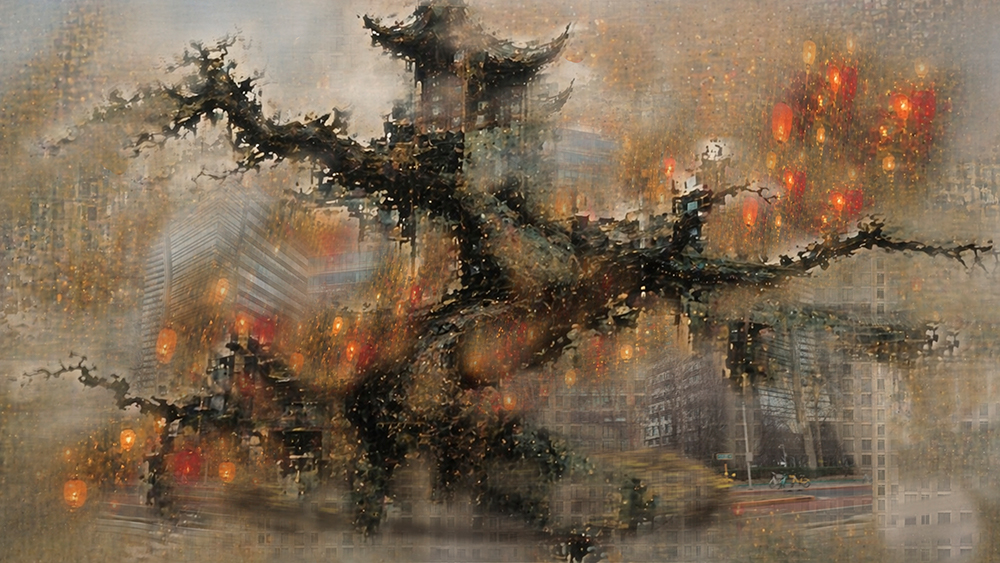
Emily Alana James | Tensions in Modern China | 2026
At its most disciplined, the practice produces something genuinely affecting. Tensions Modern China is the strongest piece in this selection by some distance. The ancient gnarled tree bleeding into the grid of a contemporary Beijing façade, traditional lanterns hovering in the amber haze between two temporal registers — the image achieves its argument through restraint. The texture has room to breathe. The contradiction between rootedness and erasure, between an organic world and a rationalized one, is present in the very surface of the image rather than being stated. It is the work doing what the artist says she wants to do: expressing what words cannot.
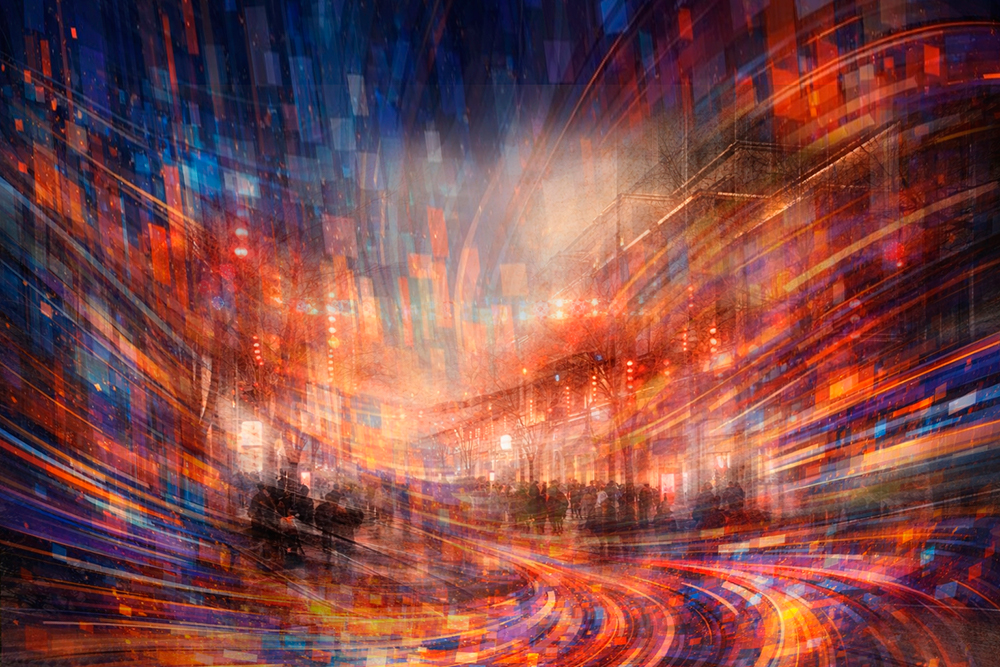
Emily Alana James | City of Change: Beijing | 2026
City of Change Beijing operates with a different strategy — kinetic saturation, the city as centrifuge — and it largely succeeds because the motion blur and the architectural fragmentation serve a unified visual logic: the experience of being inside an event too large to comprehend. The silhouetted figures at ground level anchor the human scale, which prevents the abstraction from becoming merely decorative.
Where the work becomes more uneven is in its relationship to accumulation. Spring Festival is undeniably alive with colour and cultural energy, but the layering here tips from density into crowding: dragon, festival mask, lanterns, crowd, architecture compete for priority without a clear hierarchy of attention, and the image is simultaneously too much and somehow less than the sum of its parts.
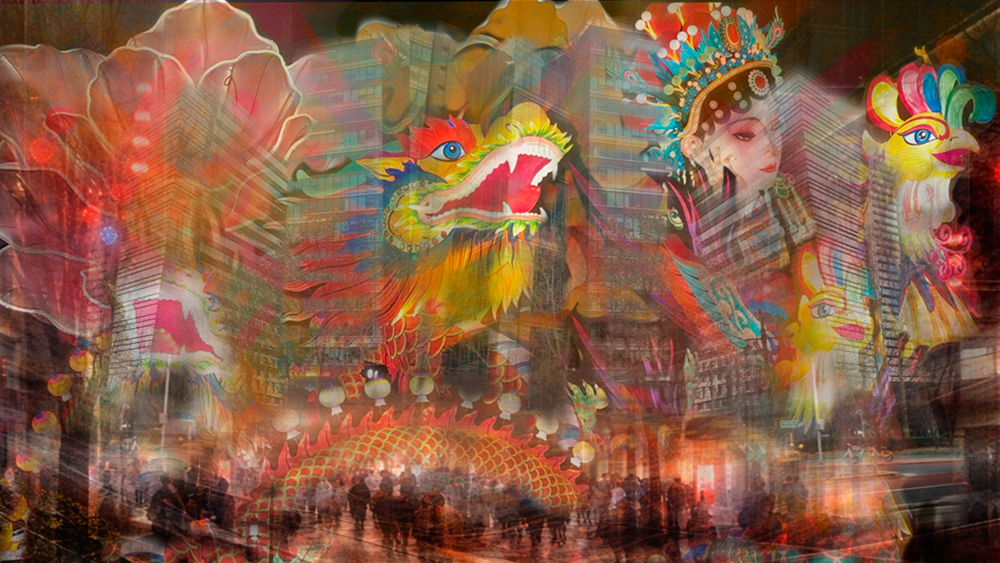
Emily Alana James | Spring Festival | 2026
The problem is compositional rather than conceptual — the idea is sound, but the eye has nowhere to settle. Similarly, Emergence from the Storm of Change deploys an impressive geometric vocabulary (the interlocking tori are formally striking) but the relationship between that central form and the atmospheric field surrounding it feels more assembled than resolved; the background carries the aesthetic language of City of Change Beijing without the same structural coherence.
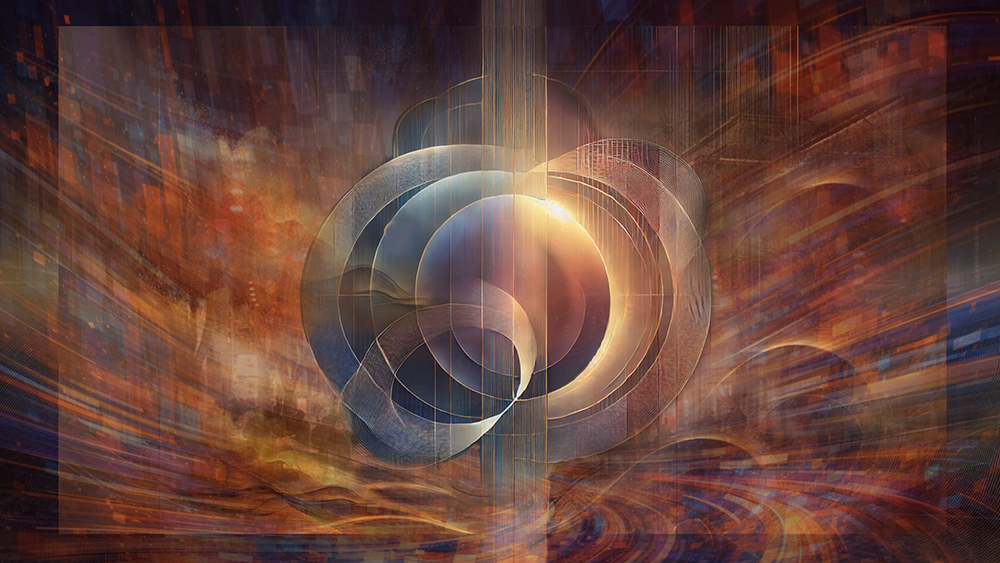
Emily Alana James | Emergence from the Storm of Change | 2026
China Lanterns, which reads as the most purely generative of the group — an abstract energy field of light ribbons and textured ground — is technically accomplished and carries a certain meditative quality, though it sits at some distance from the China-specific cultural enquiry animating the stronger pieces. It could belong to any number of artists working in this digital register.
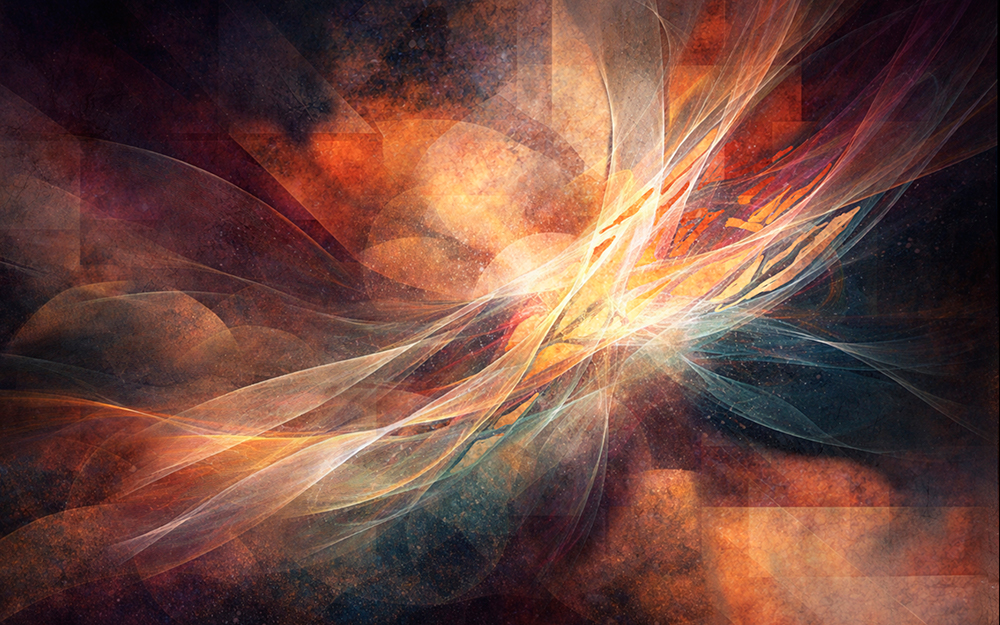
Emily Alana James | Chinese Lanterns | 2026
The most provocative inclusion is Memories of Florence, which is a different kind of image entirely: the artist herself, holding a cat, composited into a Florentine skyline wrapped in the characteristic geometric structures that appear throughout the series. It is a self-portrait, a memory object, and a declaration of methodology all at once. The personal presence is disarming — and the image is honest about what digital layering can also be: the self projected into a constructed world. Whether that honesty is fully intentional or partly unguarded, it is the most revealing work here.
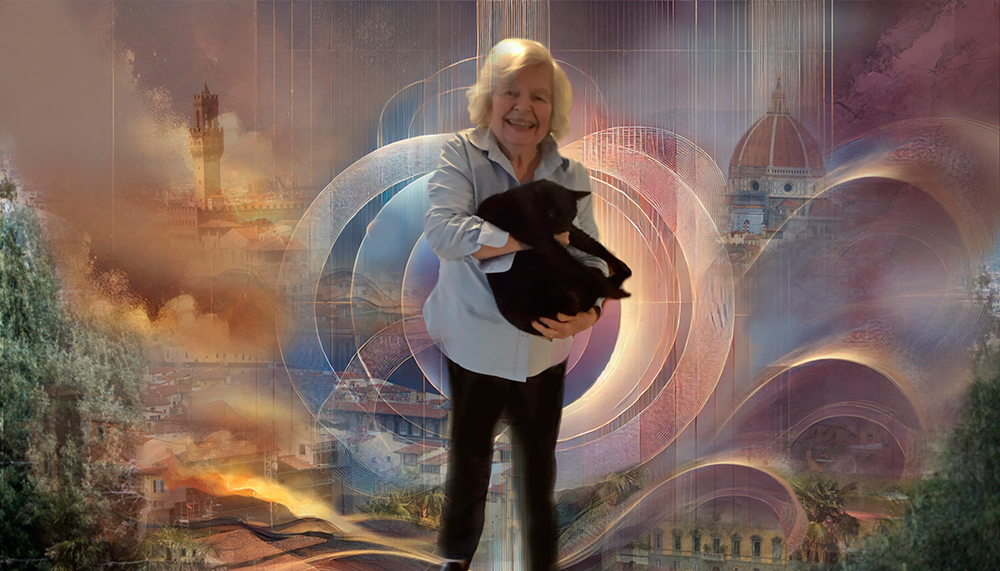
Emily Alana James | Memories of Florence | 2026
A practice spanning more than fifty years, inflected now by generative AI as a creative collaborator, carries with it the genuinely interesting question of where the artist’s eye ends and the tool’s affordances begin. In the strongest works, that question dissolves into the image; in the weaker ones, it reasserts itself. James’s most valuable instinct — stillness inside complexity — is most audible when she trusts subtraction as much as addition.