

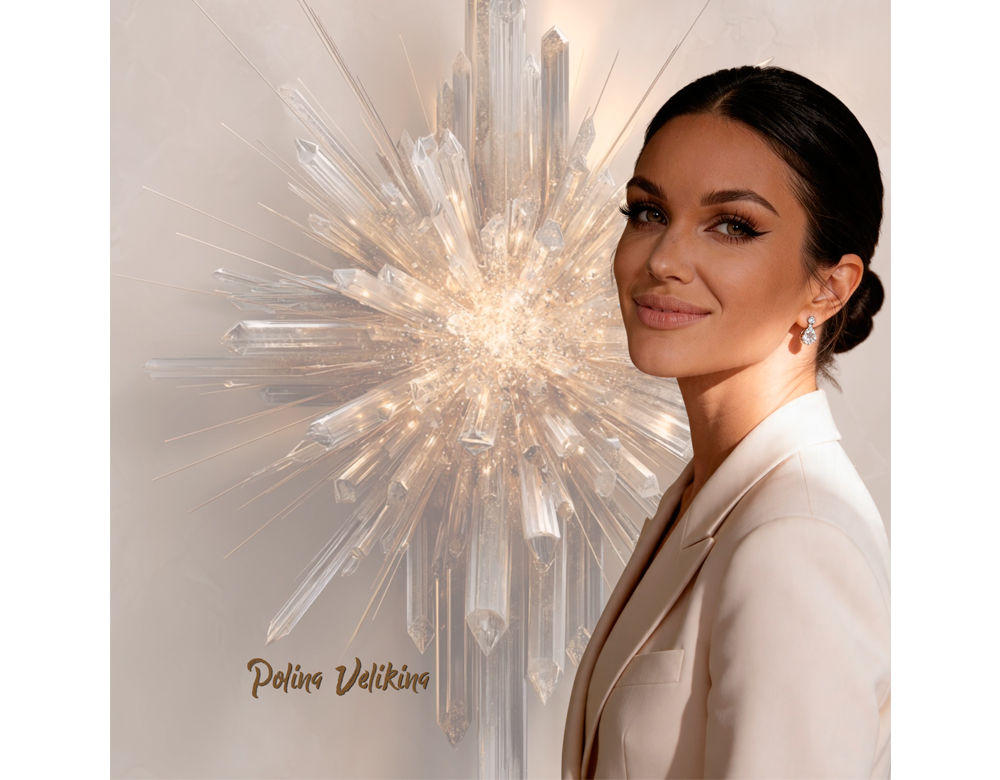
Polina Velikina’s “DIVINE PULSE” is a series of twelve conceptual portrait works that positions itself at the intersection of portraiture, spatial psychology, and atmospheric design. The body of work reviewed here — comprising four distinct pieces — demonstrates a practiced command of visual language and a coherent conceptual ambition: to render interiority not as narrative but as environmental condition. The results are compelling in their consistency, and occasionally remarkable, though the project raises questions about the tension between its stated intellectual framework and its visual accessibility.

The first work — a dark, charcoal-toned portrait of an upturned face dissolving into a deep black field — is arguably the strongest piece in the selection. The tonal control is exceptional: Velikina manages the transition between skin and shadow with the confidence of a painter who understands chiaroscuro not as technique but as metaphor. The face barely holds itself together against the darkness, and this visual instability is precisely the point. If presence is the theme, its fragility is honestly represented here. The brushwork, whether rendered digitally or physically, preserves a convincingly haptic quality that prevents the image from feeling cold.

The second piece — a red-jacketed figure framed within a gold-and-geometric mandala — represents the series’ most formally resolved work. The integration of iconographic structure (the halo, the symmetrical architecture, the fractured painterly surface) with portraiture is handled with restraint. The subject’s cool, direct gaze against an almost devotional compositional logic creates a productive ambiguity: this is neither saint nor secular figure, and that indeterminacy is the work’s most interesting feature. The colour palette of crimson, gold, and off-white feels considered rather than decorative.

The third work — the abstract fragmented portrait shows ambition in its layered transparency and muted palette. The dissolution of form — planes of grey, white, and ochre intersecting across a ghostly face — conveys interiority convincingly. This piece functions best as a study in restraint and is arguably the most aesthetically consistent work in the group.

The fourth image — a richly layered collage-style work featuring tropical botanics, a face with bold red lips, and textural detail — is the most maximalist of the series and the most commercially legible. Displayed on canvas with a Certificate of Authenticity (limited to 2/3), it signals a clear orientation toward the collector’s market. The Certificate’s presence is a notable choice: it foregrounds the work’s status as object rather than concept. This is not a criticism in itself, but it sits in some tension with the artist’s claim that the series functions primarily as a spatial-psychological instrument.
Velikina’s work sits at the intersection of conceptual art and spatial psychology, offering a unique contribution to the dialogue on how art interacts with contemporary interiors.
The portraits in DIVINE PULSE do not shout for attention; rather, they exert a gravitational pull through “silent strength”. This makes them particularly effective in architectural contexts where they function as stabilizers rather than mere decorations.
By treating portraiture as a system, Velikina moves beyond the “who” of the subject to the “how” of the presence. The works do not just represent a person; they transform the atmosphere of the space through their conceptual weight.
Conclusion
Polina Velikina proves herself to be an artist of profound conceptual clarity. DIVINE PULSE is a testament to the power of art to act as a psychological foundation within our physical structures. Through her innovative use of materials and her architectural approach to the human form, she has redefined the role of the portrait in the contemporary interior, offering images that do not just reflect reality, but stabilize it.