

Curatorial Review
by Oleksandr Dyvnich
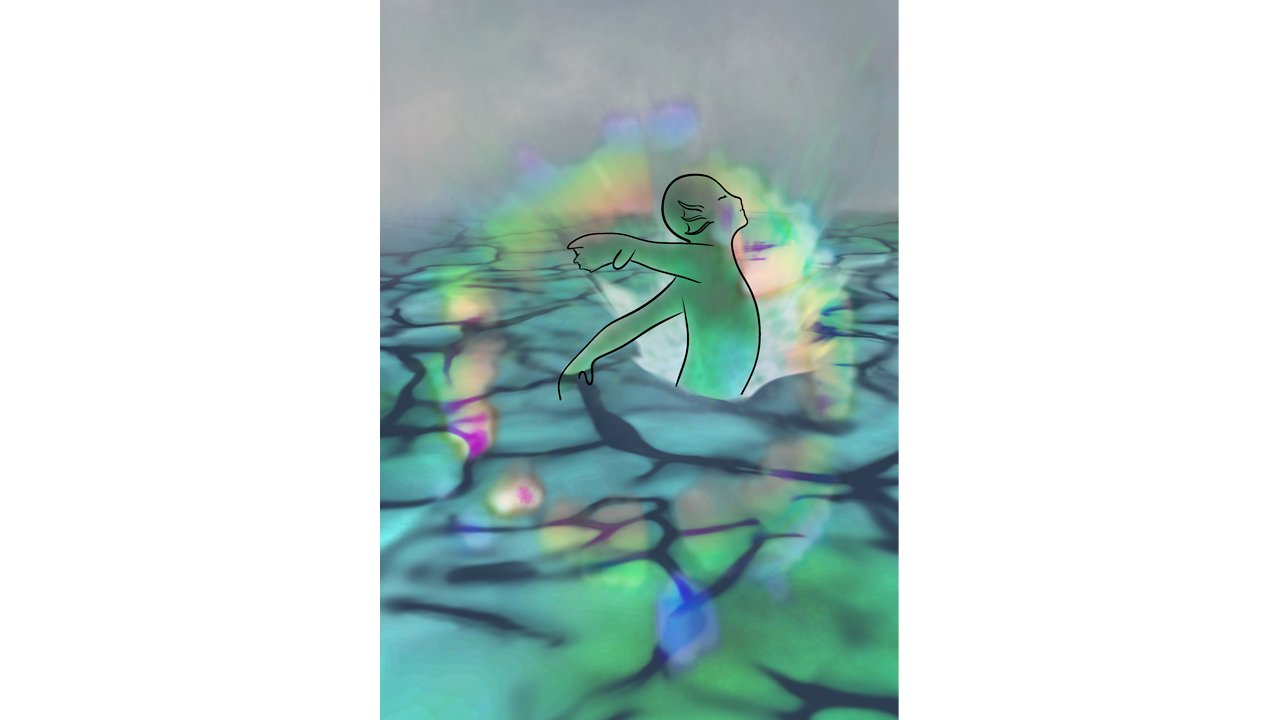
At first glance, these three digital works read as a sequence, almost a short visual narrative in three movements. A pale figure dives head-first toward a whale; a dark silhouette falls backward as bubbles race toward a distant surface; a green figure rises from a cracked, veined ground with arms thrown wide like wings. Taken together, they trace a passage from descent through submersion to emergence. This is a structure as old as myth, but here it is given a distinctly contemporary charge.
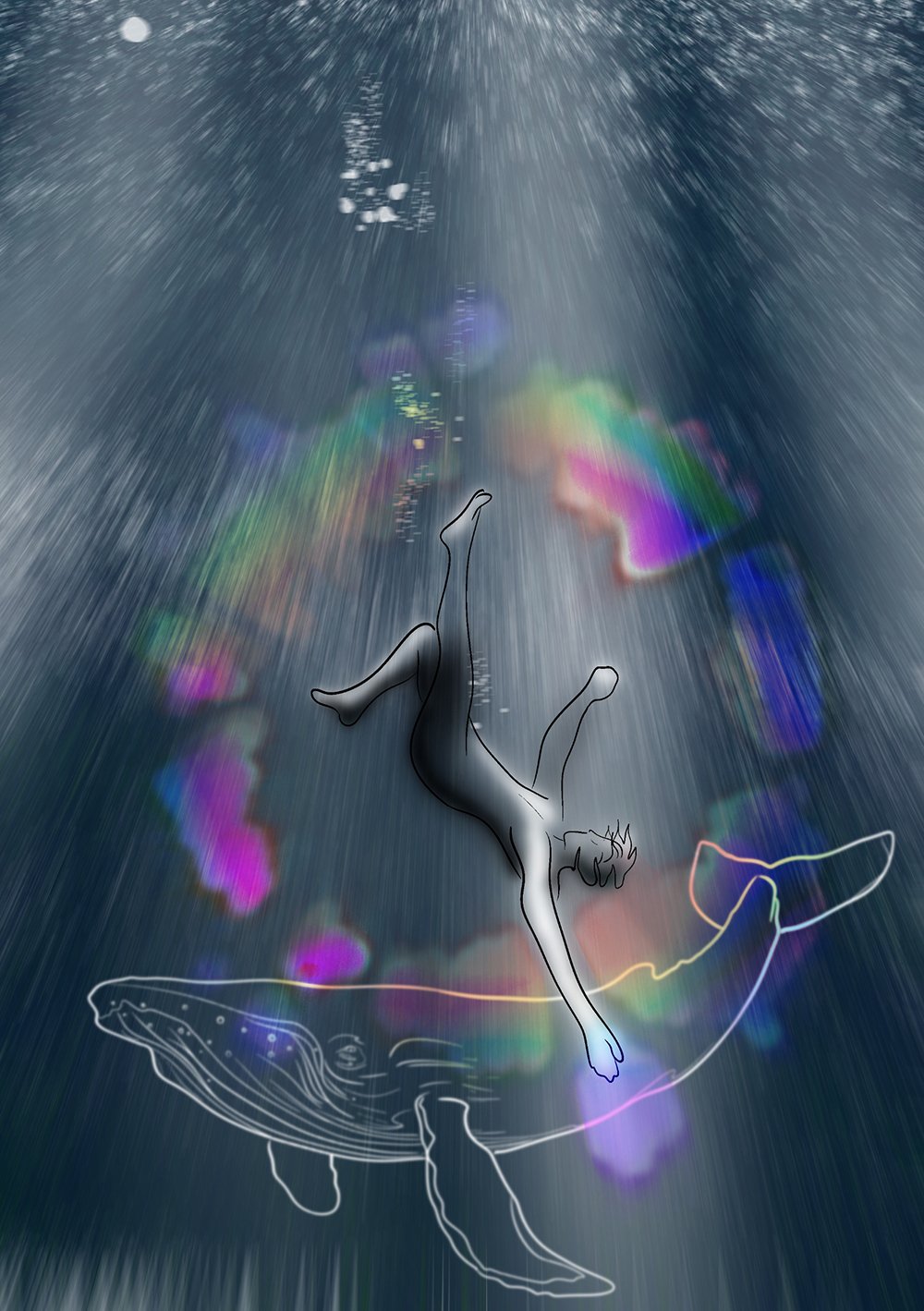
The first image is the most fully resolved. The artist sets a luminous human body, rendered in soft grey gradients and a confident black contour, against a whale drawn only in fine white line. The whale’s outline turns iridescent along its back and tail, shifting through amber, pink and violet. It feels less like an animal than a memory or a spirit guide, present yet unreachable. The figure’s outstretched hand, glowing blue at the fingertips, almost touches it. The composition hinges on that near-contact, and the tension holds.
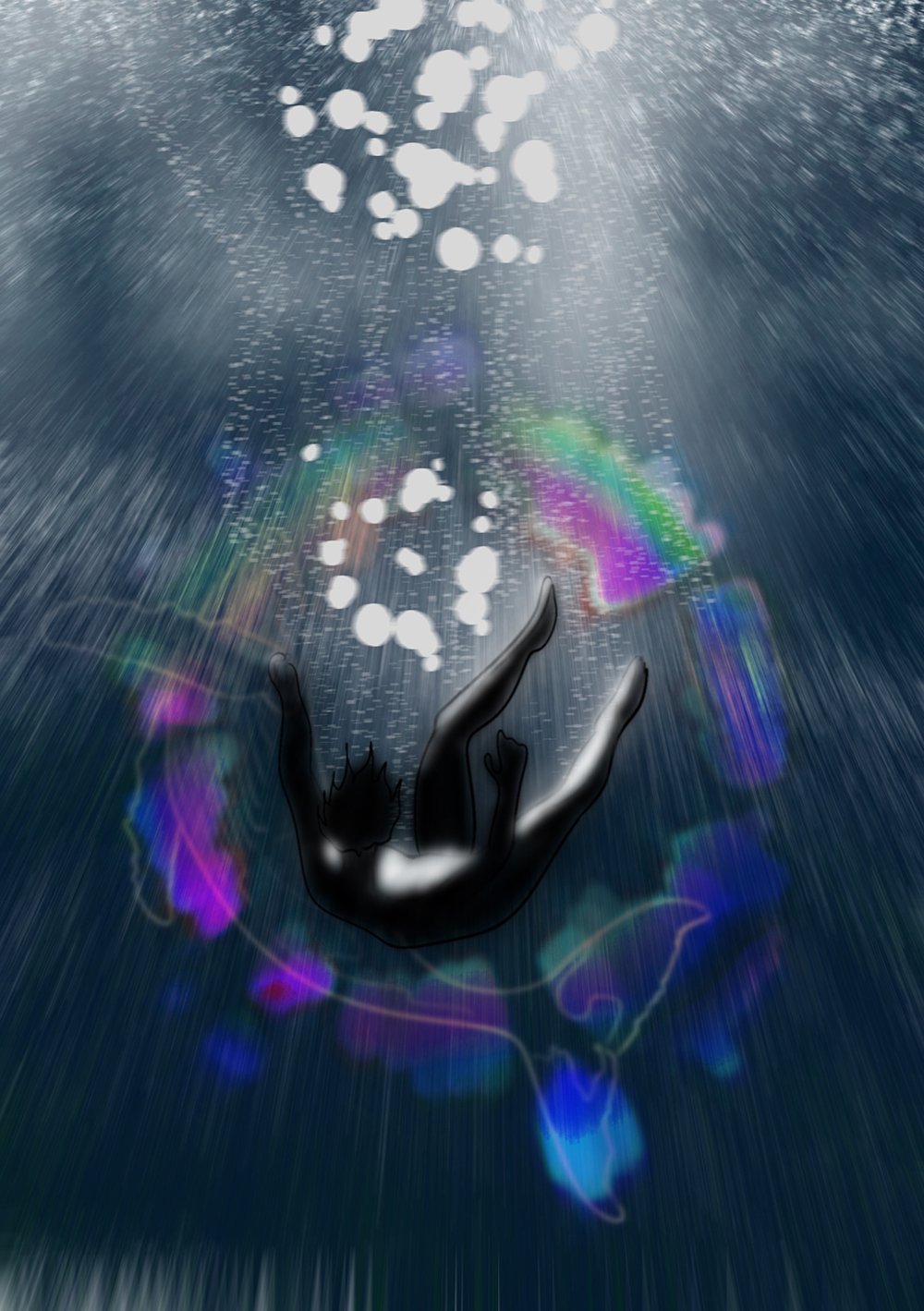
In the second work, the palette darkens and the figure becomes a solid black silhouette, while the whale fades to a ghostly trace. Large, flat white bubbles dominate the upper half of the picture. They are deliberately graphic, even naive, and they contrast sharply with the streaked, rain-like texture of the water. The effect is disorienting in a productive way. We cannot tell whether the figure is sinking or being released, drowning or letting go.
Across both underwater scenes, a ring of blurred prismatic colour hovers around the figures. This is the series’ most interesting and ambiguous device. It can be read as refracted sunlight, as an oil slick, or as a fractured rainbow. Given the artist’s commitment to marine conservation and to queer visibility, each of these readings is plausible, and the refusal to settle on one is to the work’s credit. Beauty and contamination, pride and vulnerability occupy the same space.
Across both underwater scenes, a ring of blurred prismatic colour hovers around the figures. This is the series’ most interesting and ambiguous device. It can be read as refracted sunlight, as an oil slick, or as a fractured rainbow. Given the artist’s commitment to marine conservation and to queer visibility, each of these readings is plausible, and the refusal to settle on one is to the work’s credit. Beauty and contamination, pride and vulnerability occupy the same space.
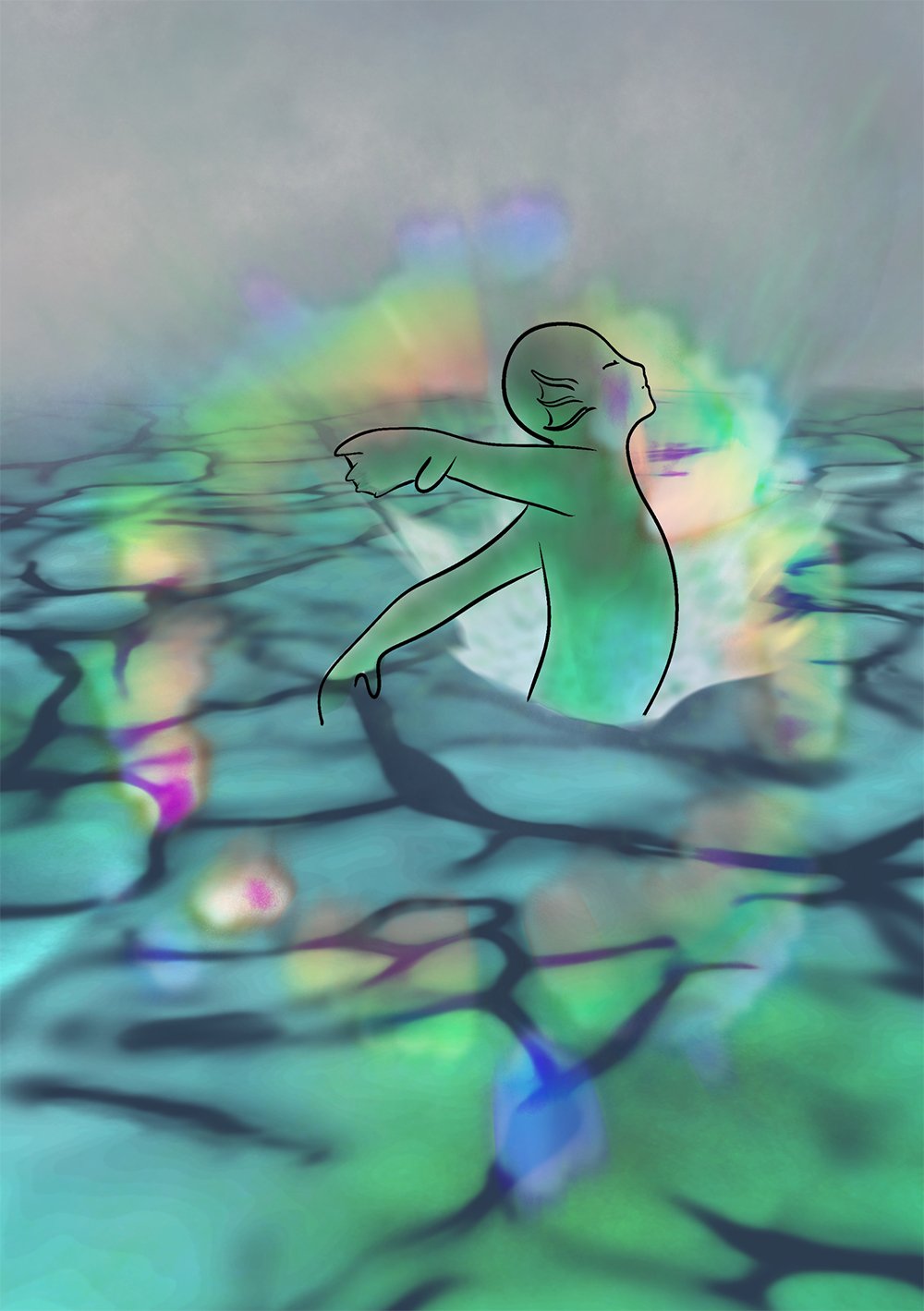
The third image shifts register entirely. Its tones are pastel and hazy, and the figure is simplified to a bald, almost embryonic form. Around it, the ground splits into a network of dark fissures that recall drought-cracked earth, leaf veins, or the surface of water seen from below. The upturned face and open arms suggest arrival rather than escape. It is a hopeful ending, though not a naive one.
Still, the series coheres around a genuine concern: how a body finds its place in a damaged, shifting world, and how it might surface again. For an artist whose practice centres on creating safer spaces for others, these works offer something similar to the viewer: a quiet, open-ended place to sink, breathe, and rise.
Still, the series coheres around a genuine concern: how a body finds its place in a damaged, shifting world, and how it might surface again. For an artist whose practice centres on creating safer spaces for others, these works offer something similar to the viewer: a quiet, open-ended place to sink, breathe, and rise.