


Curatorial Review
by Oleksandr Dyvnich
Spencer Herd brings the eye of a lighting designer to the discipline of paint. Trained in illuminating stages rather than canvases, he treats colour as a controllable, gradated resource — something to be built up in careful increments until it behaves the way light behaves: never flat, always shifting depending on where and how long you look. That sensibility is the clearest throughline in this body of work, and it is also its greatest asset.
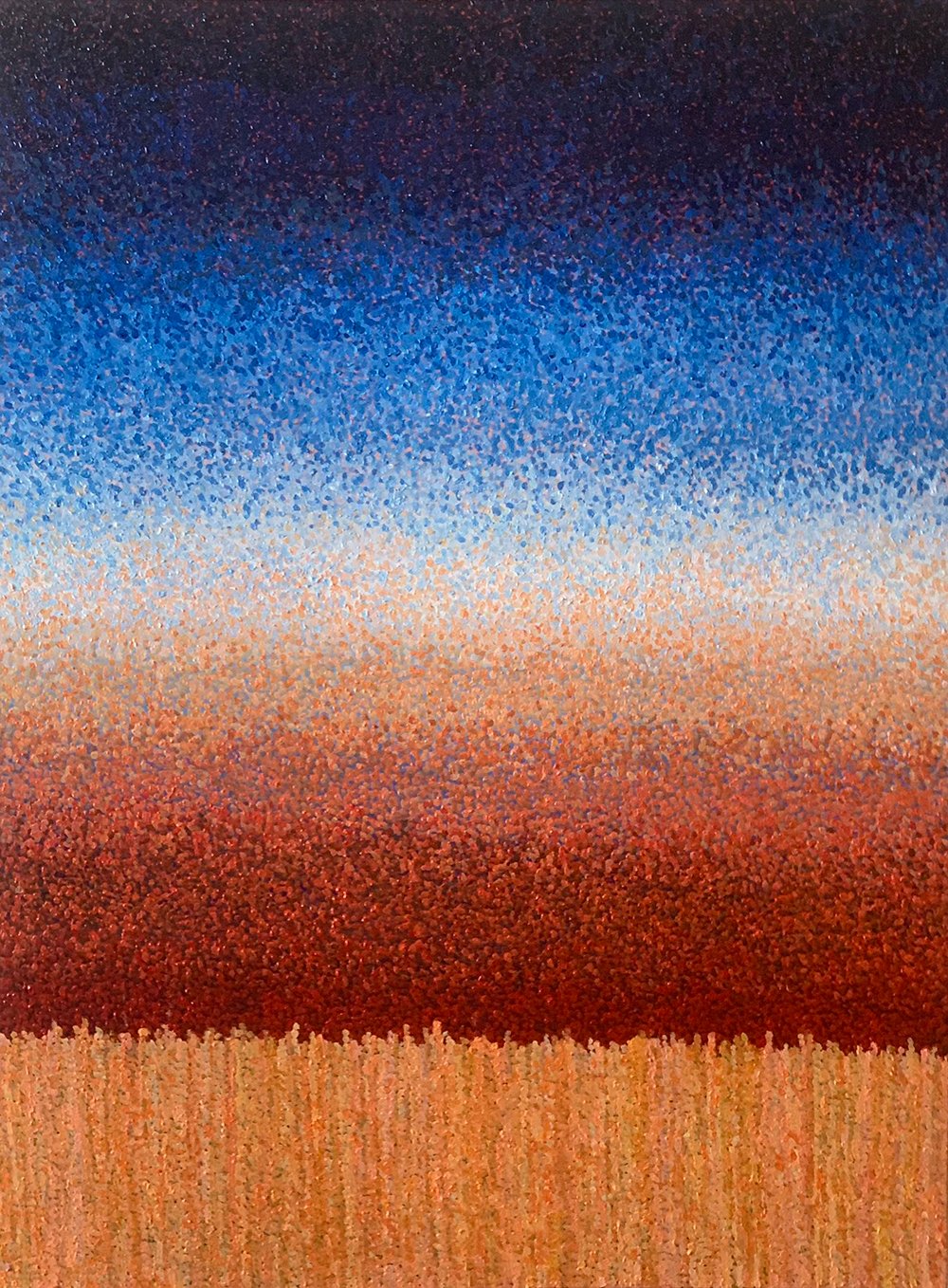
Spencer Herd | A Page Over Pingelly
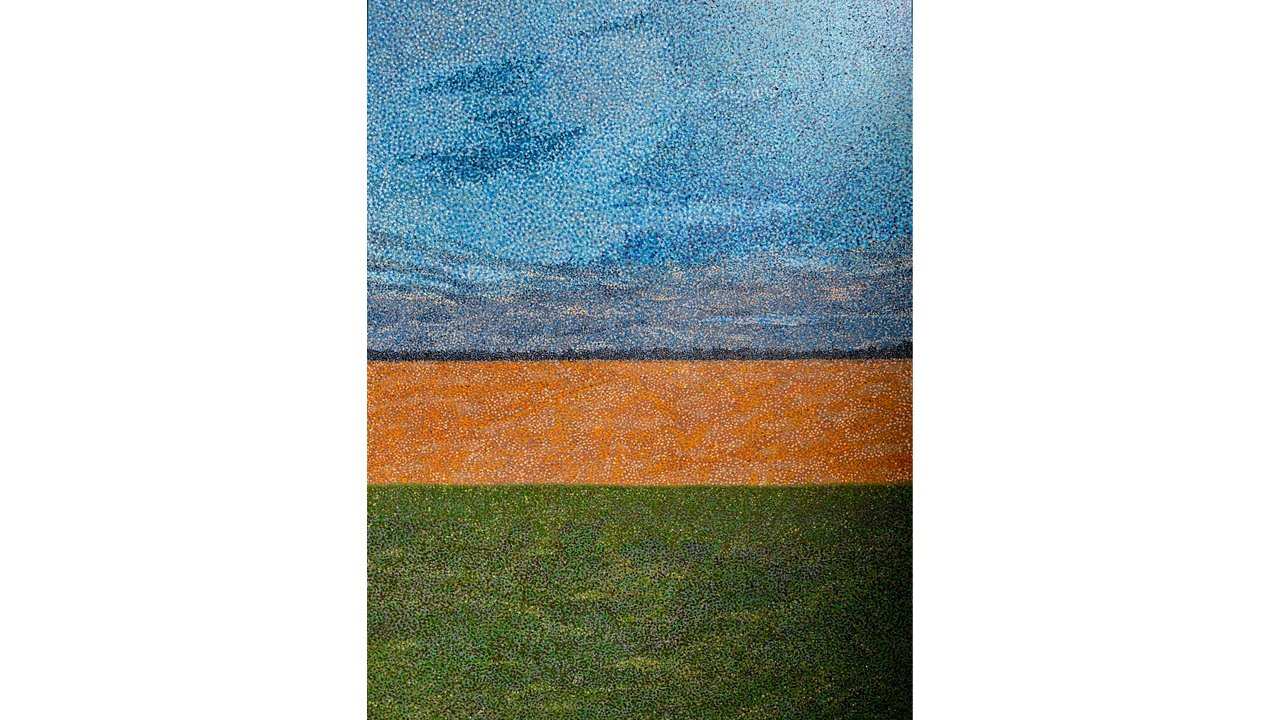
The strongest pieces are the sky-and-horizon compositions — A Page Over Pingelly, Playa Chac Mool, and the title work, Feels Like Very Clean Air in Scotland. Each divides the canvas into simple horizontal bands: a darkening upper register, a warm middle zone, a grounded foreground. Within that plain scaffolding, Herd’s pointillist technique earns its keep. Thousands of individually placed marks accumulate into atmosphere rather than illustration — the transition from indigo night to ember-orange horizon in A Page Over Pingelly reads less like a painted gradient than a genuinely optical event, flickering slightly as the eye moves across it. This is where the artist’s stated aim, to reward both the distant glance and the close, sustained look, is most fully realised.
The statement frames the title work around memory and the fragility of shared time with another person, and the painting carries that weight better than the wall text does. Its power is atmospheric rather than narrative: the image does the emotional work through colour temperature and the quiet, almost held-breath horizon line, not through any legible incident. Viewers will feel the tenderness of the claim before they can articulate why.
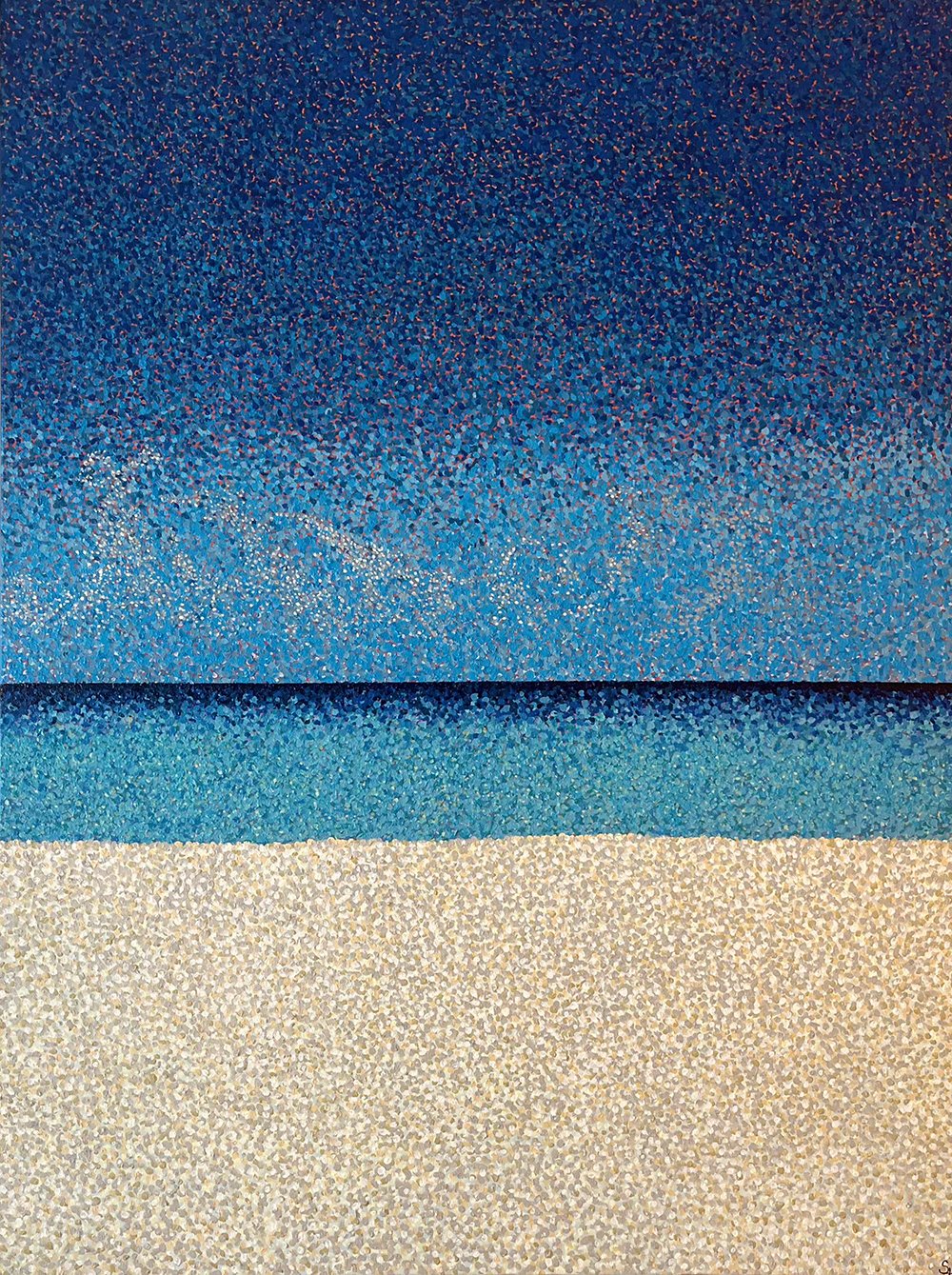
Spencer Herd | Palaiya Chak Mool
The more abstracted works are less evenly resolved. AO isolates the geometry of tiled water into a near-abstraction of blue facets and grouted lines — a confident, well-observed fragment.
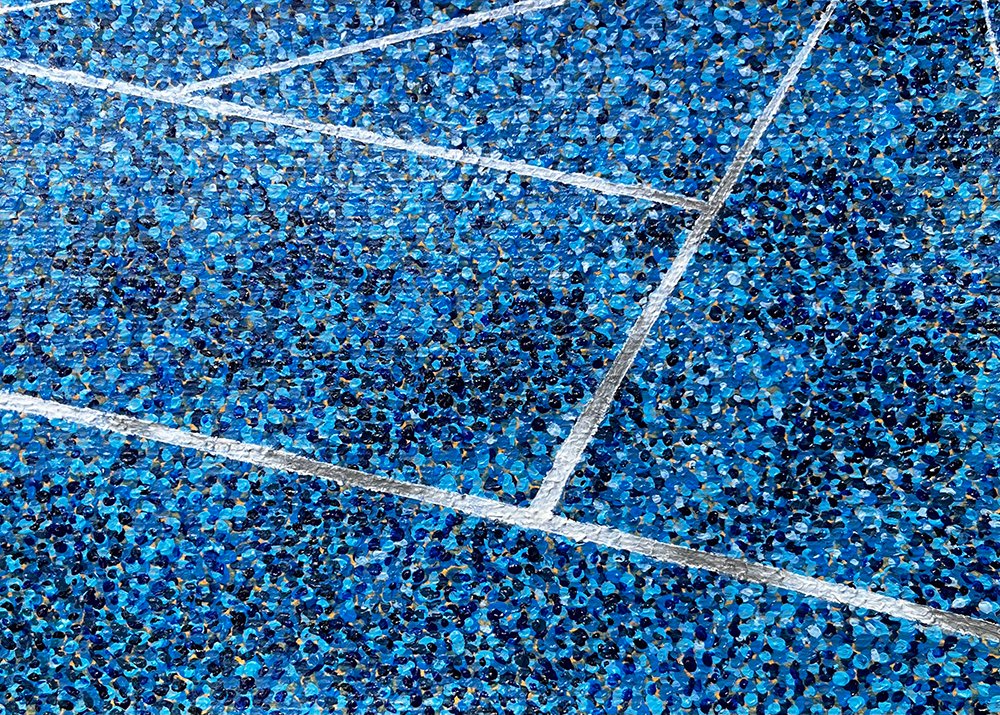
Spencer Herd | AO
Blue Lagoon, by contrast, reduces its subject to a dark organic shape floating in a field of sandy dots, and the ambiguity here feels less deliberate than unfinished; without a stronger compositional anchor, the eye searches for a subject that never quite arrives.

Spencer Herd | Blue Lagoon
30,000 is the most experimental piece on offer, pairing a hot, impasto-thick upper register of gouged copper marks against a cooler, more graphic lower field of grey linear strokes over green stippling. The juxtaposition is bold and the paint handling is the most physically assertive in the group, but the two halves do not yet speak to each other — the piece reads as two studies sharing an edge rather than one resolved statement.
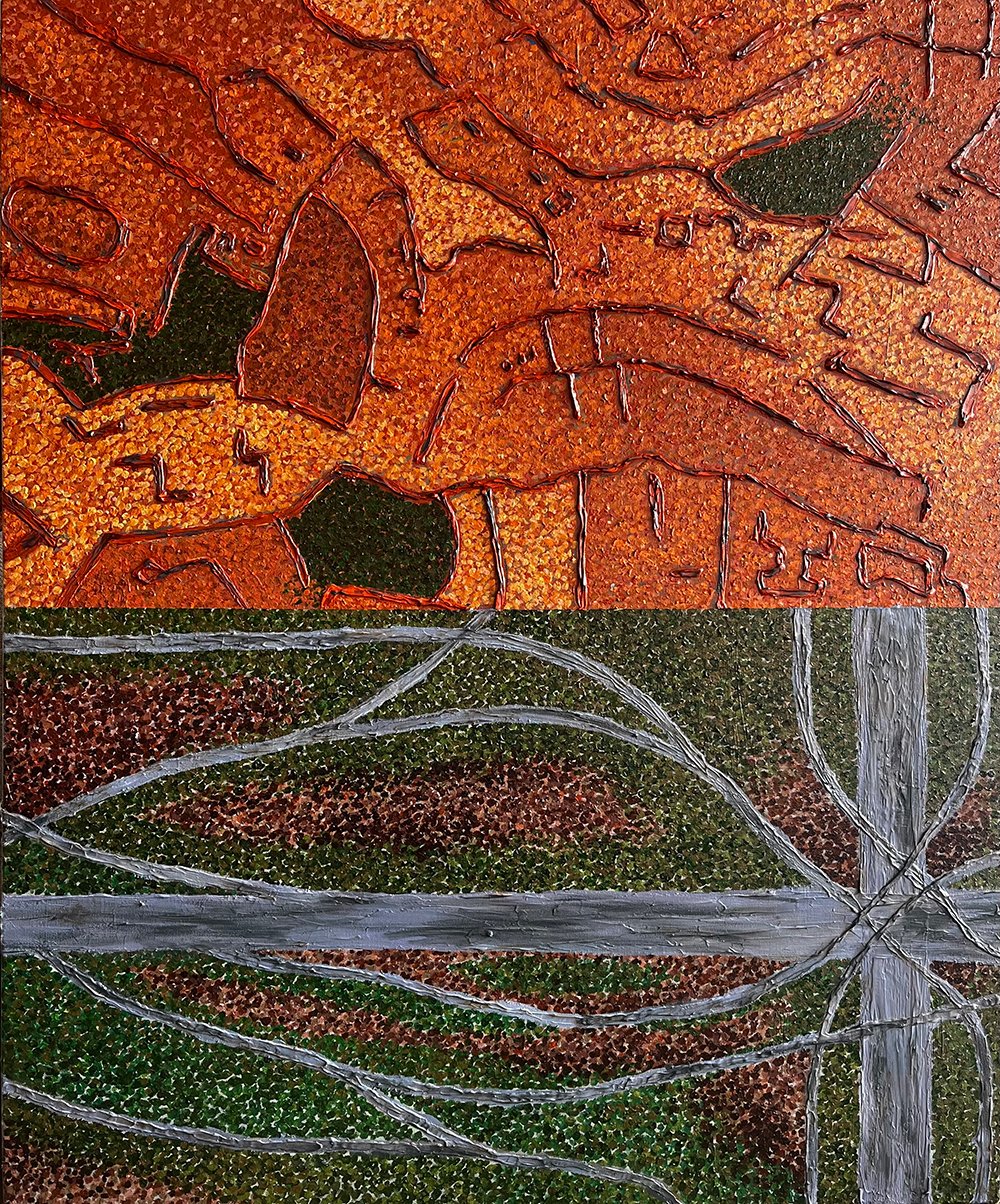
Spencer Herd | 30,000 – None
Across the group, the horizon-band format that serves the landscapes so well is beginning to function as a default rather than a choice, and a comparison across the six works here makes the repetition more visible than any single painting would. Herd’s technical control of gradient and his evident command of colour temperature — skills clearly informed by his career designing stage light — are not in question. What would sharpen this practice further is a comparable rigour in composition: some of these paintings could be swapped for one another without losing much, while the strongest, Feels Like Very Clean Air in Scotland, earns its specificity through a slightly more assertive foreground and a title that insists the image is anchored to one particular place and moment. More of that specificity, and a willingness to let 30,000’s more turbulent, unresolved energy bleed further into the calmer landscapes, would give the next body of work a sharper edge.
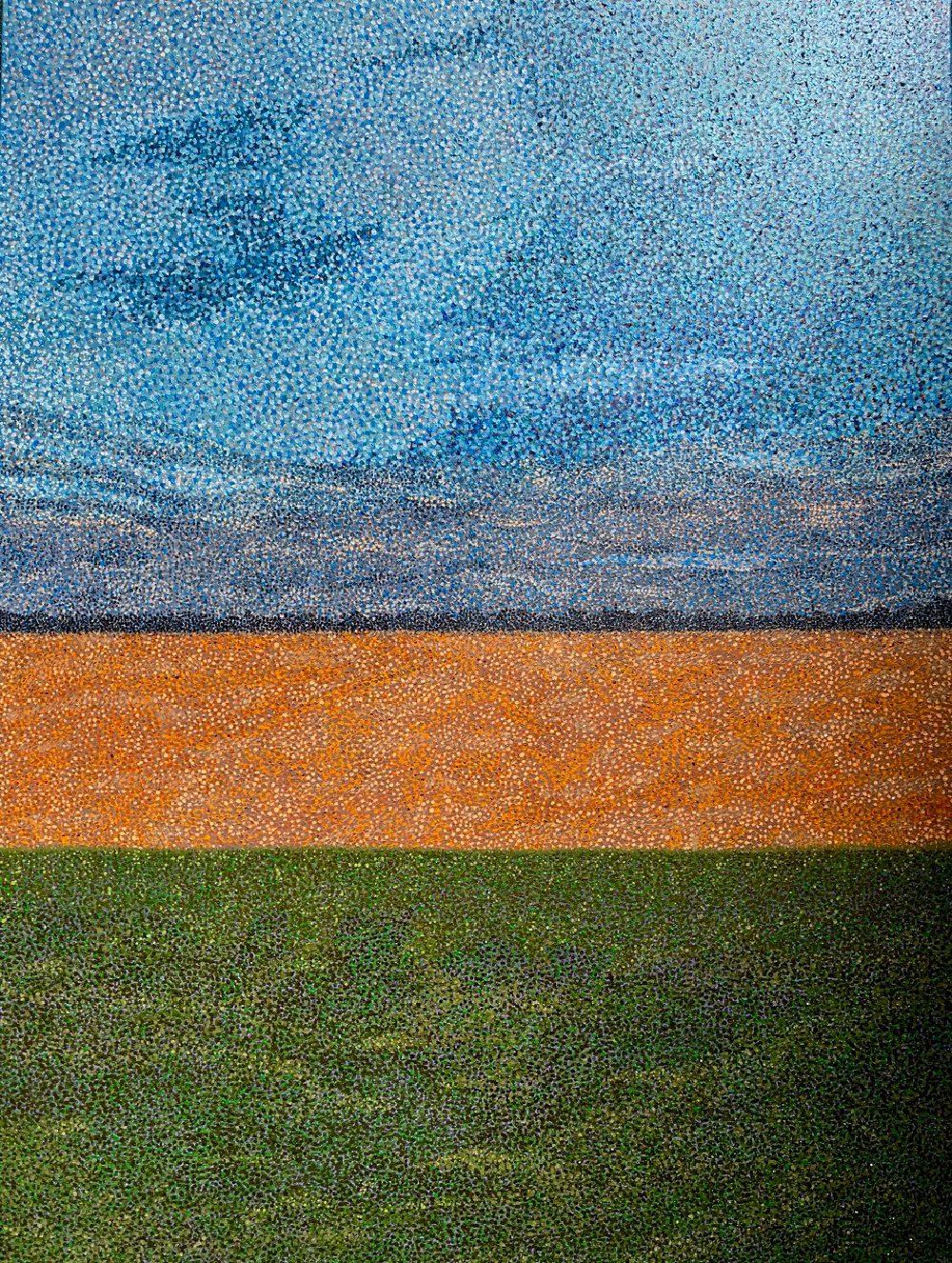
Spencer Herd | Feels Like Clean Air in Scotland | 2026
Herd’s theatrical credentials — recent lighting design work on Eurydice and Amplified: The Exquisite Rock and Rage of Chrissy Amphlett, a Green Room Award nomination, and the 2026 Kristian Fredrikson Award — are not incidental biography. They explain why these paintings think in terms of illumination and atmosphere before they think in terms of subject. That cross-disciplinary instinct is Herd’s most distinctive asset as a painter, and the work here is at its best when it trusts that instinct completely.